Trompe l'Oeil in an Ordinary House: Where an Illusion Works
Trompe l'oeil is art that gives the illusion of being three-dimensional, and a few rooms in nearly every house are made for it.
October 16, 2026 · 4 min read
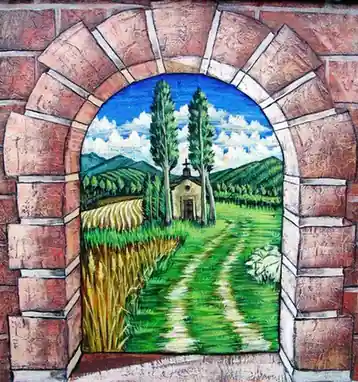
Trompe l'oeil means 'fools the eye,' and the idea is plain: a flat wall painted so convincingly that your brain reads depth. A stone arch where there is only drywall. A window onto a lane that doesn't exist. A balustrade you could swear you could lean on. Done well, it's one of the most surprising things a painter can put in a house. Done in the wrong place, it looks like a poster stuck on the plaster.
Most houses have a few spots where the illusion is easy, and a few where it never will be. Knowing which is which is most of the job.
Where an illusion works
Look for places where the room already suggests an opening. Arches are the classic case. A plain opening between two rooms becomes grander when the painter adds stonework, keystones and shadow. A blank end wall at the end of a hall can become the far side of an arch, with a view through it. A billiard room painted through a brick arch makes a game room feel like part of a larger old house.
Windows are another natural. A wall without a window, or a room with a view onto the neighbor's siding, can get a painted window that shows what you'd rather see: a cypress lane, a garden, a stretch of countryside. The trick is to frame it the way a real window would be framed, with trim, a sill and the soft edge of a curtain, so the painted view has a believable border. Without the frame, it's just a landscape. With it, it's a window.
Niches and alcoves work the same way. A shallow recess in a hall or dining room can hold painted shelves, a painted statue or a painted urn, lit from the same direction as the real light in the room. They make an architectural moment out of a dead corner.
Ceilings are the quiet winner. A sky with clouds, a coffered ceiling, a ring of leaves around a light fixture: overhead illusions are easy to believe because we can't walk up to check. A ceiling painted with open sky changes the whole proportion of a small room and keeps the walls free for furniture.
Light, perspective and the one viewpoint
Three rules make an illusion hold together, and a good painter works to all of them.
- Light has to match the room. If the real window is on the left, the shadows in the painting fall to the right. A shadow cast the wrong way is the quickest way to break the spell.
- Perspective has to match where people stand. An arch is drawn from a typical viewpoint, usually the doorway or the spot where you'd sit. From across the room it works. From a sharp angle it starts to bend, and that's normal for any illusion.
- Color has to match the air. Things far away go softer and cooler. A cypress lane at the end of a painted window that is as saturated as the foreground reads as a sticker.
Texture counts as well. Painted stone with a hint of surface variation, painted brick with uneven mortar and tiny shifts in color, painted wood with a believable grain: this is where faux finish skill and mural skill meet. Renaissance Revival Painting does both, which helps, because a convincing arch is half mural and half faux stone.
Where an illusion fights the room
Some rooms resist it. A small room that's already busy, with bold furniture, patterned wallpaper on the next wall and a lot of art, doesn't need another picture asking to be believed. The illusion competes and nobody wins.
Walls with real architecture fighting for attention are a problem too. A fireplace, a built-in bookcase and a pair of windows already make a composition. A painted arch layered over that can feel like one statement too many. Likewise, a painted window on a wall that sits right next to a real window invites a side-by-side comparison, and the painting loses.
Low light and strong glare are the enemies of painted depth. If one wall gets a hard stripe of afternoon sun, the shadows in the painting and the shadows in the room will argue. In that case, a calmer solution, like a painted frame holding a landscape, works better than a full illusion.
The painting in the frame is also a simple middle path. It's a trompe l'oeil frame: the clipper ship in our portfolio sits in a painted frame on a red wall, and the frame has depth, shadow and a molding that looks carved. It reads like a hung painting, and it asks less of the room than a full opening does.
Planning one for your house
Start by walking through the house and noting where a surface is blank and the eye keeps drifting. Take photos at the height you'd normally see the wall from, and again from the doorway. Note where the real light comes from and when. Decide what you'd like to see on the other side: stone, sky, a view, a garden, a collection of objects.
A painter will usually sketch it in place, often with tape or chalk on the wall, so you can see how it sits against the trim and the furniture before any paint goes on. Walls get prepped like any other mural wall: cleaned, patched, smoothed and primed.
Renaissance Revival Painting has been creating trompe l'oeil and other murals since 2001, and the studio quotes for free. Call (401) 351-4757 or reach us through the contact page with a couple of photos of the wall.
Renaissance Revival Painting, (401) 351-4757
Call (401) 351-4757More articles
Venetian Plaster Versus Faux Finish Paint for Your Walls
Plaster is something you feel with your hand; a faux finish is something you read across the room, and each belongs in different rooms.
Planning a Mural for a Child's Room or a Family Room
A good mural starts with a decision about the wall, not a picture, and the picture comes second.