Venetian Plaster Versus Faux Finish Paint for Your Walls
Plaster is something you feel with your hand; a faux finish is something you read across the room, and each belongs in different rooms.
October 16, 2026 · 4 min read
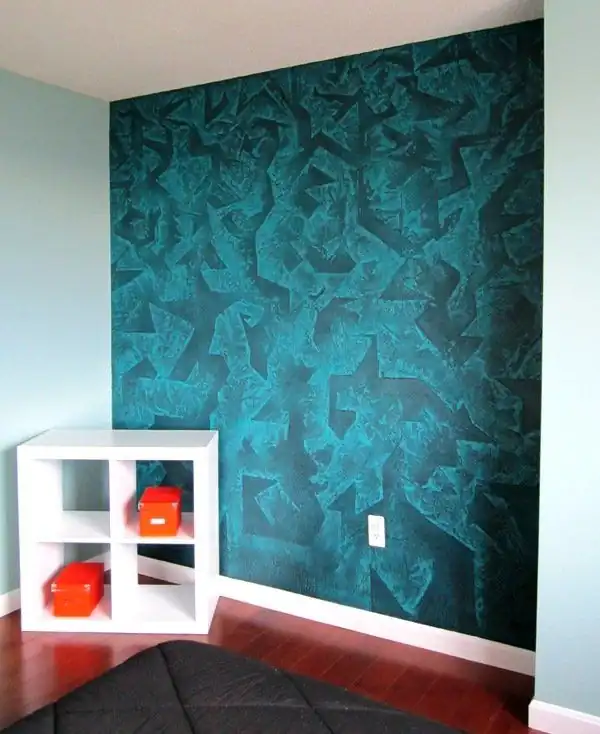
Walk into a room with a good Venetian plaster wall and the first thing you'll do is put your hand on it. That's the whole pitch. Plaster has depth you can feel, a soft sheen that shifts as you walk past, and a cool, smooth surface that rolled paint can't imitate. A faux finish done in glaze and paint gives you something different: pattern, color movement and character on a wall that still feels like a wall. Both belong in a house. They just don't belong in the same rooms.
What Venetian plaster actually is
Venetian plaster is built up in thin layers. The painter trowels on a tinted plaster in short, crossing strokes, lets each pass firm up, and goes back over it with a clean steel trowel, pressing hard enough to compress and polish the surface. The first layers hide the wall and set the color. The last ones are burnished until the surface shines softly, a little like polished stone. Because it's troweled and not rolled, no two walls come out the same. The way the painter's hand moves ends up in the finish.
The look runs from quiet to dramatic. Pull the plaster tight and polish it hard and you get a calm, marble-like wall with cloudy depth. Leave more trowel marks and a lower sheen and it reads like aged limestone on the wall of an old house in Italy. Either way, the color sits inside the material instead of on top of it, which is why a plaster wall looks different at breakfast than it does under lamplight.
What a faux finish is
Faux finishing is a family of techniques done with paint and glaze: ragging, striping, faux marble, faux brick, metallic paint, texture and more. The common thread is that you start with a prepared, painted wall and then add translucent layers on top, pulling, dabbing or rolling them so each layer shows through the one below. Ragging, for example, works a glaze over a base coat with a rag so the base color peeks through in soft clouds. Striping is the opposite: crisp and measured, with taped edges and a plan for exactly where each band lands.
Faux finishes cover more stylistic ground than plaster does. A marbled column in a dining room, a brick wall in a house that never had brick, a metallic accent over a fireplace, lettering in a stairwell. At Renaissance Revival Painting the faux work includes Ragging, Striping, Venetian Plaster, Faux Marble, Faux Brick, Faux Texture, Lettering and Metallic Paint, and which one fits comes down to what the room is asking for.
Where plaster earns its place
Plaster wants to be looked at up close and in good light. These are the rooms where it usually pays off:
- Dining rooms and formal living rooms, where people sit still and actually study the walls.
- Entry halls with a window or a good fixture, where the burnished sheen has light to travel across.
- Powder rooms and small baths, where four rich walls make a jewel box out of a tiny space.
- The wall around a fireplace, where the surface gets seen from arm's length.
Plaster is also fussy about the wall underneath. A polished surface telegraphs every ding, crack and uneven patch, so the wall gets skimmed, sanded and primed before any plaster goes on. That prep is part of the job, and it's the reason a finished plaster wall looks calm instead of lumpy.
Where a faux finish suits better
Faux finishes do more of the heavy lifting in rooms that need character without the polish. Striping that follows the height of the wainscot sets up a dining room beautifully. A glazed texture on a feature wall adds warmth to a family room.
Glaze finishes are also more forgiving of a wall with some history. A textured, mottled glaze can sit comfortably over a surface that would look tired under burnished plaster. And if you want a specific look, brick, stone or planked wood, a faux finish is the only honest way to get it, because plaster can only hint at those things.
How to decide
Stand in the room at the time of day you use it most. If it's a room where you sit and linger, plaster has the patience to reward you. If it's a room people pass through, or one with strong furniture, a faux finish with a bit of pattern or movement holds its own without demanding attention.
Think about light, too. Plaster's glow comes from light moving across it. A dim room with one small window may flatten that sheen, while a metallic glaze or a textured finish can pick up what little light there is. Heavy patterned rugs and a busy sofa will fight a striped wall, and a quiet plaster wall lets them talk.
Then ask for a sample board, painted by the person who will do the wall, and prop it in the room for a few mornings and evenings. A finish that looks right on a small board in a shop can look different at full scale, and it's far cheaper to find that out on plywood than on a dining room.
Renaissance Revival Painting is owner-operated and has been doing this since 2001, with backgrounds in fine arts and color theory behind the technique. We do plaster and glazed finishes both, so there's no pressure to push you toward one. For a free estimate, call (401) 351-4757 or send a note through the contact page, and have a few photos of the room ready.
Renaissance Revival Painting, (401) 351-4757
Call (401) 351-4757More articles
Planning a Mural for a Child's Room or a Family Room
A good mural starts with a decision about the wall, not a picture, and the picture comes second.
Trompe l'Oeil in an Ordinary House: Where an Illusion Works
Trompe l'oeil is art that gives the illusion of being three-dimensional, and a few rooms in nearly every house are made for it.